
Peptide Quality and Purity Explained: Why It Matters in Research
Quick answer: Peptide purity is the percentage of a sample that is the intended peptide rather than impurities. It matters because in research, contaminants and incorrect sequences can skew results, waste reagents, and make findings impossible to reproduce. Quality is verified with HPLC for purity and mass spectrometry for identity.
In research, your data is only as reliable as your inputs. A peptide that’s labeled correctly but is only 80% pure — or is the wrong sequence entirely — can quietly corrupt an entire line of work before anyone notices. Understanding what “quality” and “purity” actually mean is the first step to avoiding that. Here’s a plain-English breakdown. When sourcing lab-tested peptides Canada, it is crucial to ensure that the quality is verified through proper documentation.
What peptide purity actually means
Purity is the proportion of a sample made up of the target peptide, expressed as a percentage. A peptide at 98% purity means 98% of the material is the intended molecule and 2% is something else — truncated sequences, deletion products, leftover reagents, or salts from synthesis.
That remaining percentage isn’t trivial. The impurities in a peptide are usually closely related molecules created during synthesis, and depending on the experiment, even small amounts can interfere with binding, activity, or measurement.
For most research applications, 98% purity or higher is the standard to look for. Some sensitive work demands more; a quick screening assay may tolerate less. The point is to match purity to the demands of the experiment, not to chase a number for its own sake. If your protocol calls for it, you can look specifically at high-purity peptides rather than general-grade material.
Purity vs. identity: two different questions
A common mistake is treating purity as the whole story. It isn’t. Two separate questions matter:
- Identity — is this the peptide it’s supposed to be? Is the sequence correct?
- Purity — of the material present, how much is the target versus impurities?
A sample can be 99% pure and still be the wrong peptide. Purity tells you how clean it is; identity tells you whether it’s the right molecule in the first place. You need both confirmed, which is why credible quality documentation reports both.
How quality is measured
Two analytical methods do most of the work:
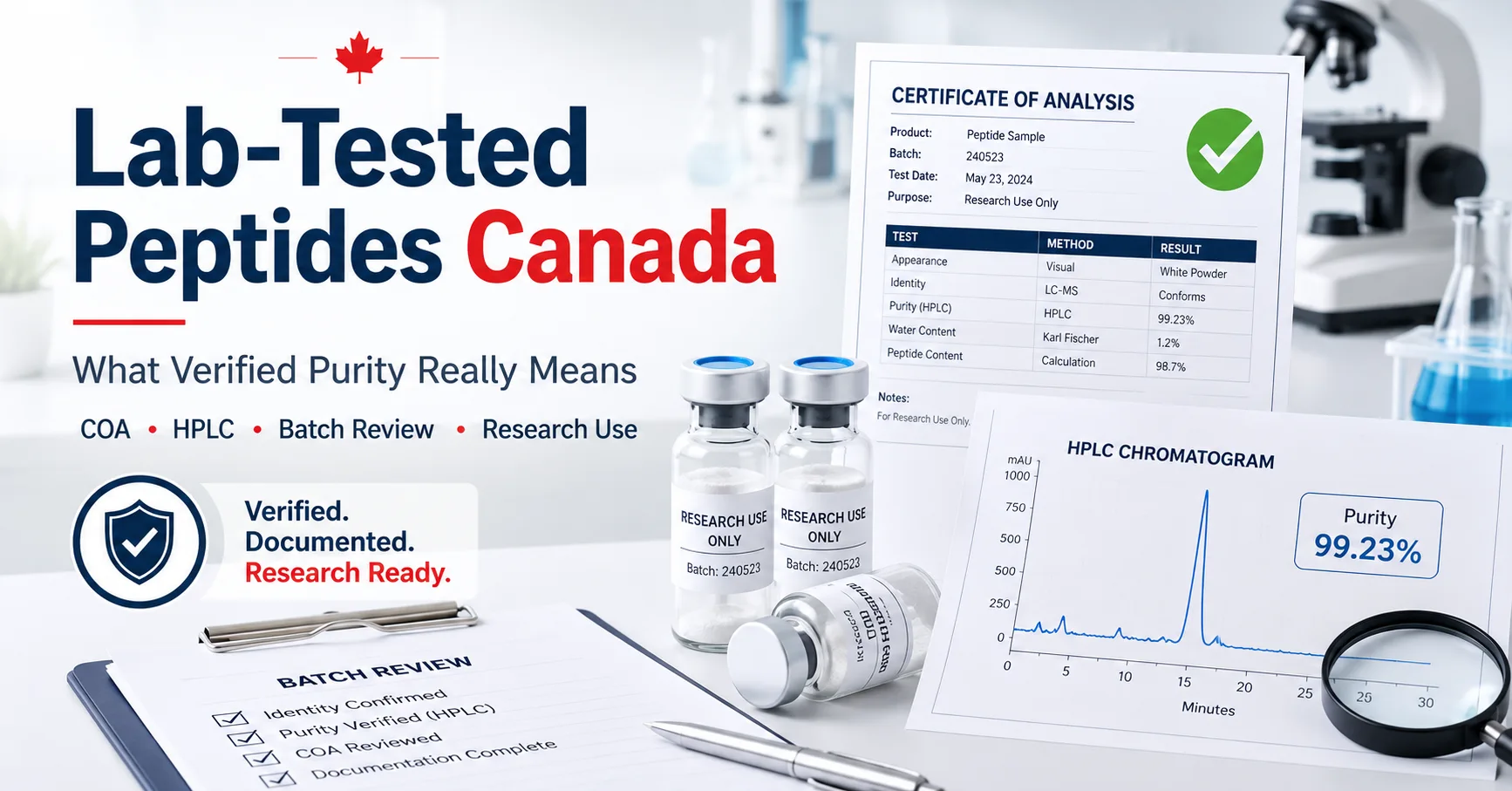
HPLC (high-performance liquid chromatography) measures purity. It separates the components of a sample so each shows up as a distinct peak on a chromatogram. The size of the target peak relative to the others gives the purity percentage. The chromatogram itself is the evidence — a stated number with no graph behind it is a claim, not proof.
Mass spectrometry (MS) confirms identity. It measures the molecular weight of the sample and matches it against the expected weight for the intended sequence. If the weights match, you have the right molecule.
Together, HPLC and MS answer both questions: the right peptide (MS), and how pure it is (HPLC). This pairing is the backbone of any legitimate Certificate of Analysis.
Why purity matters for research outcomes
Impurities aren’t just an aesthetic concern — they have practical consequences:
- Skewed results. Contaminants or related-sequence impurities can produce activity, binding, or signal that gets misattributed to the target peptide.
- Poor reproducibility. If two batches differ in purity, experiments run on each may not agree — and reproducibility is the foundation of credible research.
- Wasted resources. Time, reagents, and sample are lost chasing results that came from an impure or misidentified input.
- Misleading conclusions. The most expensive impurity is the one you never detect, because it quietly shapes findings you go on to trust.
This is why the documentation matters as much as the molecule. Verified purity and identity are what let you attribute a result to the peptide rather than to whatever else was in the vial.
What to look for in practice
When sourcing peptides for research, quality comes down to a few checkable signals:
- A stated purity percentage, ideally 98%+
- An HPLC chromatogram, not just a number
- Mass spec confirmation of identity
- A batch-specific COA tying that data to the material you’ll actually receive
- Ideally, third-party testing from a named lab
If those are present and consistent, you can trust the input. If they’re vague or missing, you’re taking the quality on faith — and faith is a poor foundation for reproducible work.
Frequently asked questions
What does peptide purity percentage mean?
It’s the proportion of a sample that is the intended peptide rather than impurities. 98% purity means 98% of the material is the target molecule.
What purity do I need for research?
It depends on the application — 98%+ is a common standard, with sensitive work requiring higher. Match purity to what your protocol actually demands.
How is peptide purity tested?
Primarily by HPLC, which separates a sample into components and measures the target peak against the rest. Identity is confirmed separately by mass spectrometry.
Is high purity the same as correct identity?
No. A sample can be highly pure but still be the wrong peptide. Purity measures cleanliness; identity confirms the molecule is correct. Both need verifying.
Where can I check a product’s quality data?
Look for a batch-specific Certificate of Analysis. You can review COA records here or browse the catalog to see how products are documented.